GLOBAL
1,119
51 groups
One trial or analytical window.
Home / Iriscope / Metric library
Iriscope · Metric library
Explore gaze, regions, reading and sequence comparisons. Find the measure that fits your question, then keep its definition, method and calculation scope with the result.
Global · AOI · Pairwise · Method context
GLOBAL
1,119
51 groups
One trial or analytical window.
AOI
233
16 groups
One named region within a case.
PAIRWISE
183
11 groups
One participant pair or item pair.
Documented registry · 30 August 2026. Counts include metric keys, aliases and provenance fields; they are not counts of independent analyses.
Start with the question
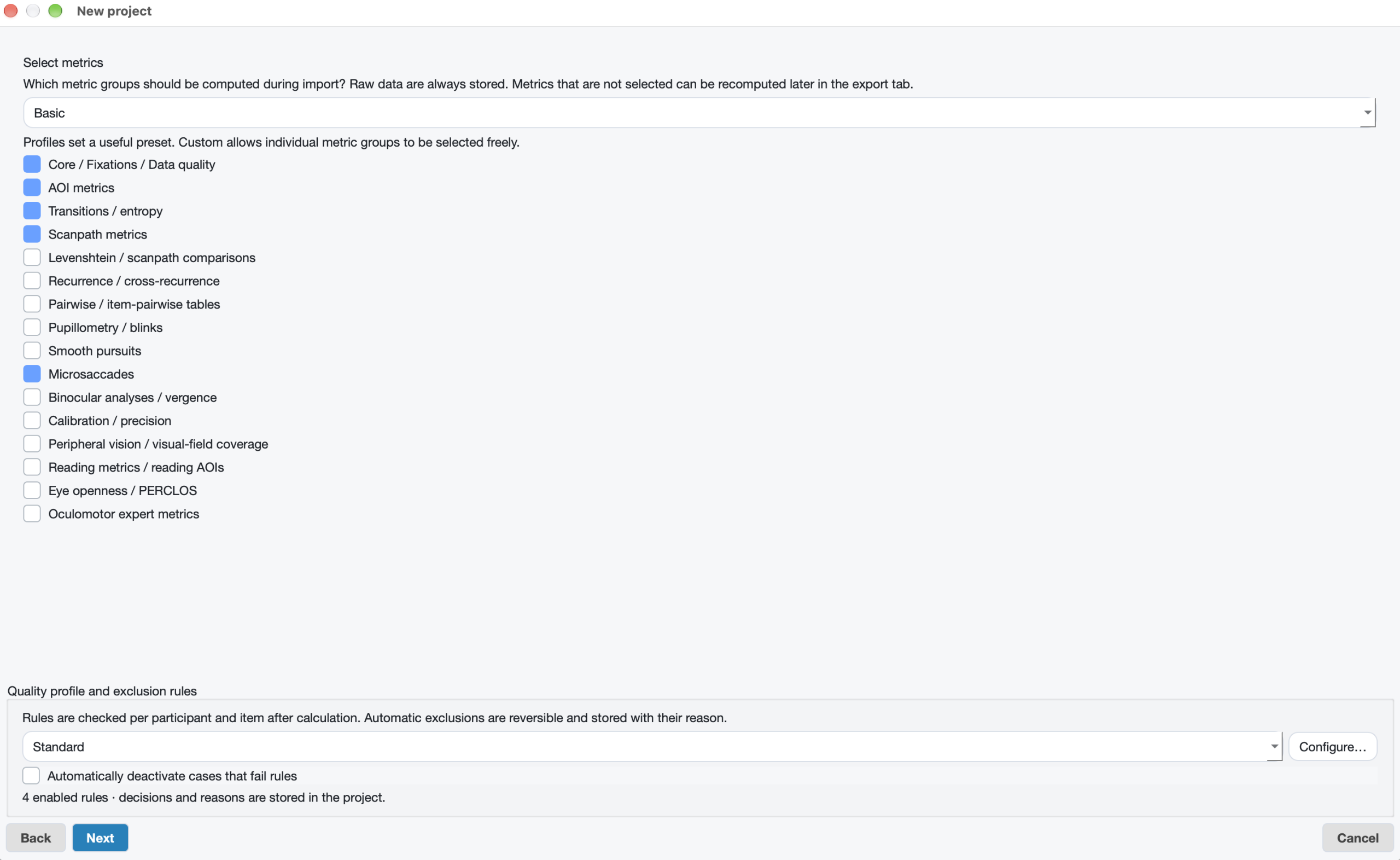
Search a topic or choose a calculation scope. Open a family for examples and the context needed to interpret it.
GLOBAL / AOI
Describe detected events and their timing. Keep the detection family attached to the result.
Count · duration · velocity
Examples. Fixation count, duration distributions and latency; saccade amplitude, peak velocity and duration. Global event groups and fixation-based AOI measures have different scopes.
Required context. Stored event sources and detection settings. Degree-based measures need display geometry and viewing distance; pixel-based results use their own units.
Reference: global §§3.2–3.12; AOI §§4.4–4.11.
GLOBAL / AOI
See how gaze time is distributed across meaningful regions, including returns and first-entry timing.
Time · share · revisits
Examples. Sample-based dwell time, gaze proportion, visits and revisits; fixation-based region counts and durations. First sample entry and first fixation latency describe different events.
Required context. Valid timestamps, gaze coordinates and the matching AOI set. Sample-based dwell and detected fixation duration use different calculation bases.
Reference: §3.14; AOI §§4.1–4.3 and §§4.4–4.11.
AOI
Compare region use relative to region size, instead of comparing dwell time alone.
Share / area share
Examples. Dwell, hit, fixation and visit density, relative density and ranks. Dwell density divides the gaze-time share by the AOI-area share.
Required context. Valid AOI geometry and the documented area convention, including time-varying geometry where used. Density above 1 indicates more gaze time relative to area.
Reference: AOI §4.13; method §7.9.
GLOBAL / AOI
Connect chronological fixation sequences to word and line regions and inspect assigned reading behaviour.
First pass · go-past · rereading
Examples. First-pass time, go-past/regression-path time, rereading, skipping, regressions and line measures. The reference documents 52 global and 47 AOI reading entries, including metadata.
Required context. Reading AOIs with text, order and layout metadata, plus stored fixations. Report the assignment and any vertical correction; a word assignment alone does not establish comprehension.
Reference: global §3.48; AOI §4.16; method §7.18.
GLOBAL / AOI
Describe movement between regions, from individual transitions to the structure of the AOI sequence.
Order · switching · structure
Examples. Transition counts, region-level incoming/outgoing transitions and Shannon entropy. Sample-based and fixation-based sequences are documented separately.
Required context. The AOI set, sequence source, treatment of outside states and relevant detection family. These choices affect the meaning of an entropy or transition value.
Reference: global §§3.15–3.22; AOI §4.12.
GLOBAL / PAIRWISE
Compare AOI sequences across trials or participants, and explore patterns in looking strategies.
Within · between · item pairs
Examples. Levenshtein distances, ScanMatch-style sequence similarity, MultiMatch-style resampled dimensions and exploratory strategy assignment. Pairwise exports support participant pairs or item pairs.
Required context. Comparable sequence sources, AOIs, time windows and normalisation. Iriscope’s adapted similarity procedures must be reported with their actual definitions, rather than as original ScanMatch or MultiMatch implementations.
Reference: global §§3.23–3.33 and §3.51; pairwise §§5.5.1–5.5.5.
GLOBAL / PAIRWISE
Inspect repeated gaze states and shared temporal structure in one sequence or between two sequences.
Repetition · persistence · lag
Examples. Recurrence rate, determinism, laminarity and trapping time; cross-recurrence with and without outside states, plus directional lag profiles.
Required context. The sequence definition, embedding/threshold settings, outside-state treatment and time basis. A lag profile describes temporal structure; it does not by itself establish causation.
Reference: global §3.34; pairwise §§5.5.6–5.5.10.
GLOBAL / AOI
Describe pupil responses and missing-signal or eye-closure patterns within a defined analytical scope.
Baseline · change · signal quality
Examples. Pupil change, window summaries and area under the curve; pupil/blink measures within AOIs, plus global eye-openness and PERCLOS entries.
Required context. The relevant recorded channels, baseline and gap-processing settings. Missing tracking, pupil loss, blinks and eye closure require distinct definitions; pupil change needs the experimental context.
Reference: global §§3.13, 3.35–3.37 and §3.49; AOI §4.14.
GLOBAL / AOI
Describe the spatial relationship between gaze, visual-field zones and stimulus regions over time.
Zones · intersections · timing
Examples. Foveal, parafoveal and peripheral summaries, gaze-to-region geometry and time-matched AOI measures. The reference lists 46 global and 18 AOI entries.
Required context. Display geometry, viewing distance, configured zones and aligned gaze/AOI timing. These geometric measures do not directly show what a participant recognised.
Reference: global §3.47; AOI §4.15; method §7.17.
GLOBAL
Use specialised event and signal measures when the recording contains the required channels and precision.
Pursuit · microsaccades · vergence
Examples. Smooth pursuits, target-following measures, microsaccades, binocular/vergence measures and additional oculomotor descriptors.
Required context. Adequate sampling and signal quality, binocular channels where required, and target trajectories for target-based measures. An unavailable result is different from a measured zero.
Reference: global §§3.42–3.45 and §3.50.
GLOBAL
Assess the recording and spatial spread before treating derived values as comparable evidence.
Validity · loss · calibration
Examples. Sample validity, gaps and tracking loss; spatial gaze distribution, calibration and precision summaries. Data quality has 32 registered entries in this reference.
Required context. The recorded validity channels, coordinate units and available calibration evidence. Include quality and exclusion criteria when reporting the analysis.
Reference: global §§3.1, 3.13, 3.38 and 3.46; workspace §6.2.
GLOBAL
Carry the calculation context with the value, including the event source and any correction state.
Settings · AOI set · analysis state
Examples. Calculated detection parameters, AOI-set and analysis-state identifiers, correction scope and coordinate-stream provenance. Saved recipes retain reusable configuration.
Required context. These fields document the analysis. An analysis recipe is a configuration; an analysis state identifies a calculated result. Changing a dependent setting can require recalculation.
Reference: chapter 2; global §§3.39–3.41.
No matching topic. Try a broader term or another scope.
These topics bring related technical groups together. The full per-key definitions and units are in the reference. Availability depends on recorded data, selected groups and calculated results.
From signal to result
The same recording can yield different event and region results under different methods. Iriscope records the choices needed to explain that difference.
01
Samples, validity and coordinate stream
02
Event source, preset and thresholds
03
AOI set and analytical window
04
Definition, unit and result scope
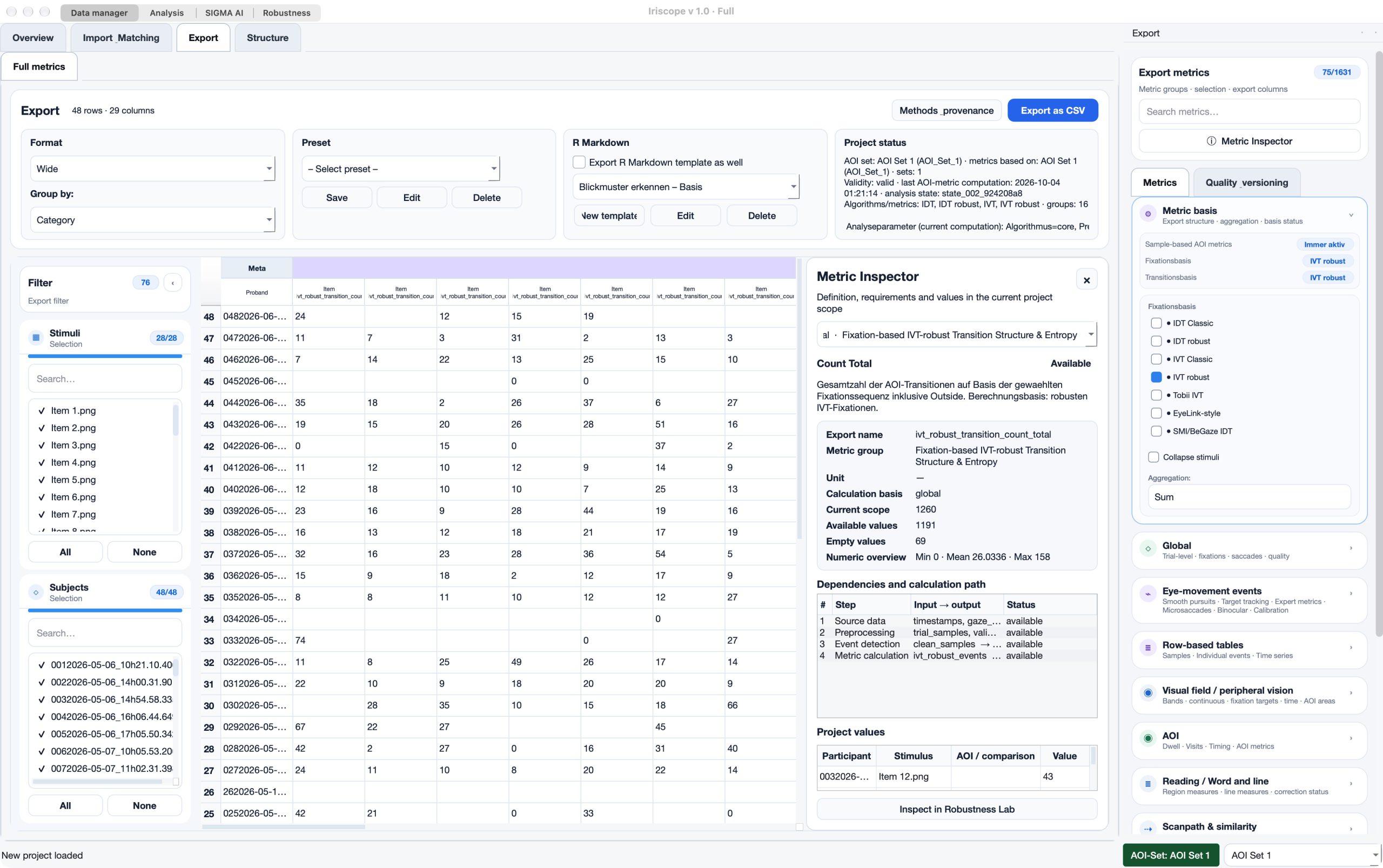
I-DT, I-DT robust, I-VT, I-VT robust, Tobii-style I-VT, EyeLink-style and SMI/BeGaze-style I-DT. Family-qualified outputs preserve the event source used for a result.
Presets define parameters and working units. Manufacturer-oriented presets are documented approximations; available family outputs depend on the stored project state.
Full-trial results and named-window results are separate scopes. Missing input or an unavailable event source must remain distinct from a measured zero.
AOI results belong to the geometry used for their calculation. Updating an AOI set or dependent configuration can require recalculation before the new context is used to interpret a stored result.
Interpret the measure within the study design. Gaze time, pupil change and reading-region assignments describe recorded or derived behaviour; their psychological meaning requires additional evidence.
In the application
Keep the region, selected cases and aggregation visible while reviewing a result.
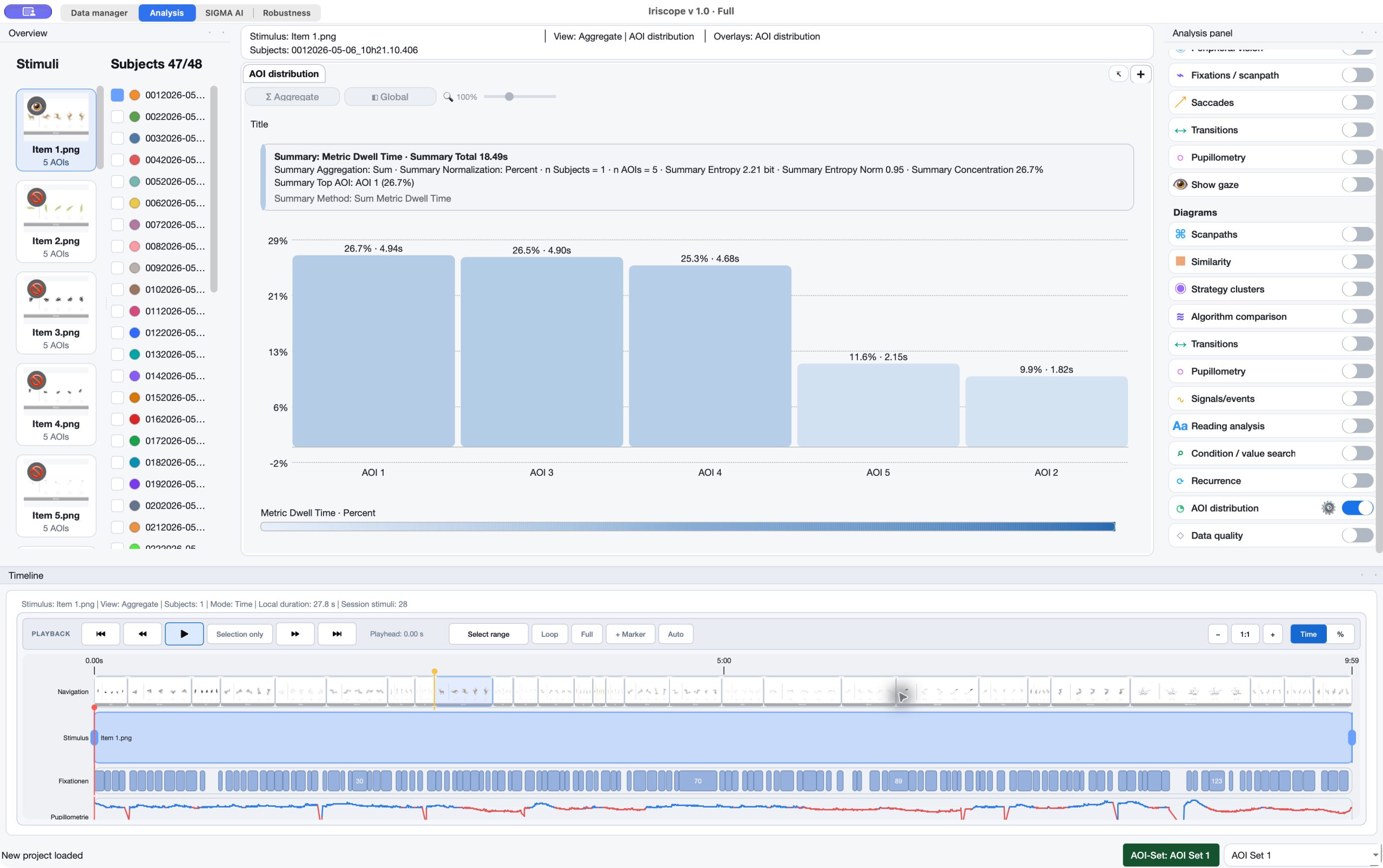
Inspect an AOI result alongside the stimulus, selected participants and timeline. Keep the chosen measure, aggregation and normalisation visible.
For a methods review, retain the detection settings, AOI set, correction state and window with the calculated result.
From analysis to reporting
The export structure follows the comparison you need. Method and provenance fields can travel with the numerical results.
Use one row per participant × stimulus in Wide, or a case/metric/value structure in Long. AOI columns retain their region names.
Compare participant pairs within a stimulus or item pairs within a participant. The documented pairwise registry has 183 columns.
Export samples, fixations, saccades and other available events, or binned signals. Source-dependent columns are separate from the static registry.
The reference documents ten technical export modes, including six event modes and binned time series.
Complete documentation
The German reference documents the registry, formulas, units, prerequisites and reporting examples across 174 pages.
German reference: registry dated 30 August 2026. The English download is an earlier edition with a previous registry; use the German reference for the counts on this page.
Your study, your measures
Tell us about the paradigm, input data and comparison you need. We can help identify the relevant metric groups and their prerequisites.